
Global Variables in JavaScript Node
Сreate Global Variables
To create a global variable using the JavaScript node, you need to:
- Add a JavaScript node to the scenario with the following code:
export default async function run({ execution_id, input, data, store }) {
 // Set Global vars directly from JS
 // String, Obj and Number are available
 const gv_str = await store.setGlobalVariable("GlobalVarFromJs_string", "global var string value");
 const gv_obj = await store.setGlobalVariable("GlobalVarFromJs_obj", {"key":"global var object value"});
 const gv_num = await store.setGlobalVariable("GlobalVarFromJs_number", 100);

 return {
 }
}
This code represents an asynchronous function run. This function is intended for execution in a web automation scenario and uses objects execution_id, input, data, and store.
The function defines global variables GlobalVarFromJs_string, GlobalVarFromJs_obj, GlobalVarFromJs_number and saves them using the store.setGlobalVariable method. These global variables can be used later in other nodes of the scenario.
- Run the JavaScript node once and wait for its execution.
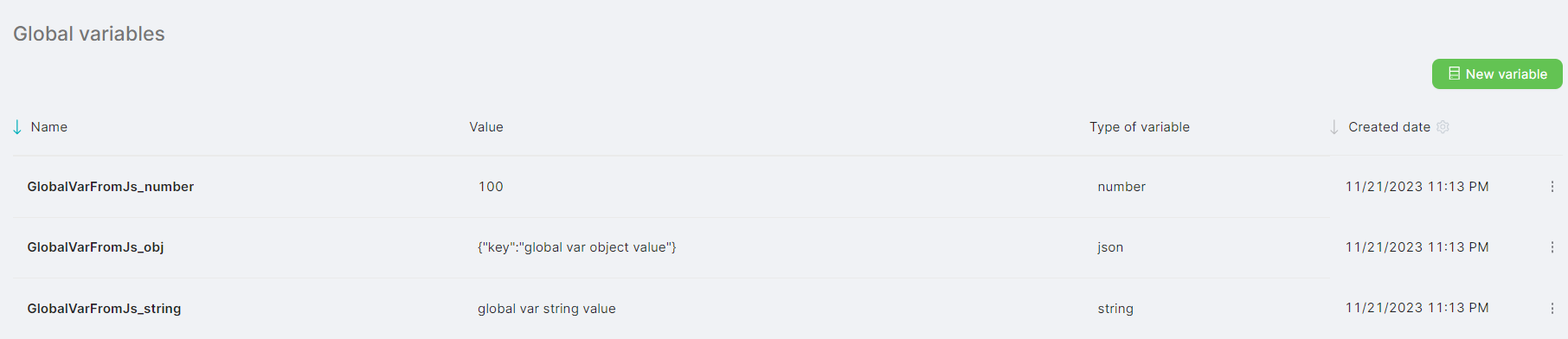
- View the globally created variables
GlobalVarFromJs_string,GlobalVarFromJs_obj,GlobalVarFromJs_numberon the Global variables interface.
- Check for the presence of new global variables when filling in the parameters of any other node:
Getting Global Variables
To get a global variable using a JavaScript node, you need to:
- Add a JavaScript node to the scenario with the following code:
export default async function run({ execution_id, input, data, store }) {

 // Get Global Vars
 const res_gv_str = await store.getGlobalVariable("GlobalVarFromJs_string")
 const res_gv_obj = await store.getGlobalVariable("GlobalVarFromJs_obj")
 const res_gv_num = await store.getGlobalVariable("GlobalVarFromJs_number")

 return {
  res_gv_str, res_gv_obj, res_gv_num
 }
}
This code represents an asynchronous function run. This function is designed to be executed in a web automation scenario and utilizes objects execution_id, input, data, and store. The code retrieves values of global variables using the store.getGlobalVariable method. This method returns values of previously set global variables.
- Run the JavaScript node once and wait for its execution to complete.
- Check the output data of the JavaScript node for the values of global variables:
Removing Global Variables
Added global variables can be deleted. To delete a global variable using a JavaScript node, follow these steps:
- Add a JavaScript node to the scenario with the following code:
export default async function run({ execution_id, input, data, store }) {
 // Del Global vars directly from JS

await store.deleteGlobalVariable("GlobalVarFromJs_string")
await store.deleteGlobalVariable("GlobalVarFromJs_obj")
await store.deleteGlobalVariable("GlobalVarFromJs_number")

 return {
 }
}
The code represents an asynchronous function run designed to be executed in a web automation scenario, utilizing the objects execution_id, input, data, and store. The function deletes existing global variables GlobalVarFromJs_string, GlobalVarFromJs_obj, GlobalVarFromJs_number using the store.deleteGlobalVariable method. Global variables are permanently deleted and cannot be used by other scenarios.
- Run the JavaScript node once and wait for its execution.
- Check for the absence of global variables
GlobalVarFromJs_string,GlobalVarFromJs_obj,GlobalVarFromJs_numberon the Global Variables interface.
Getting a list of global variables
To get a list of global variables using a JavaScript node, follow these steps:
- Add a JavaScript node to the scenario with the following code:
export default async function run({ execution_id, input, data, store }) {
 // List Global vars directly from JS

const List = await store.listGlobalVariables()

 return {
List
 }
}
The code represents an asynchronous function run designed to be executed in a web automation scenario, utilizing the objects execution_id, input, data, and store. The function allows obtaining a list of all existing global variables using the store.listGlobalVariables method.
- Run the JavaScript node once and wait for its execution.
- Examine the output data of the JavaScript node, which will contain an array of global variables. Attributes are provided for each global variable:
- Name "key";
- Type "type";
- Editability indicator "editable";
- Creation date "created_at";
- Last modification date "last_modified_at".