
Tool Design for AI Agents
Overview
Tools are nodes connected to the AI Agent that perform specific actions or return data. They must be well-defined so the agent can use them reliably.
Chain of nodes as a tool
A tool can be a chain of nodes connected to the AI Agent, not only a single node. The model receives the tool name and Tool Description from the first node in the chain. Use AI Agent Tool Response at the end of the chain to control the payload returned to the agent. See “A chain of nodes as a tool” on AI Agent Node.
Naming
Agents refer to tools by their node names. Use clear, descriptive names that directly reflect the purpose of the tool.
Good examples
create_event_toolsend_email_draftretrieve_calendar_tool
Poor examples
Node 3tempTooldoStuff
Tool names are a key part of the agent's reasoning. If the name doesn't convey the purpose, the agent may ignore or misuse the tool.
Behavior Guidelines
- Tools should be deterministic and return consistent results
- If the tool performs irreversible actions (e.g. sending an email, booking a meeting), ensure that the agent logic confirms intent before calling it
- Tools should return helpful errors when required input is missing or invalid — in a format the agent can interpret
Tool Descriptions
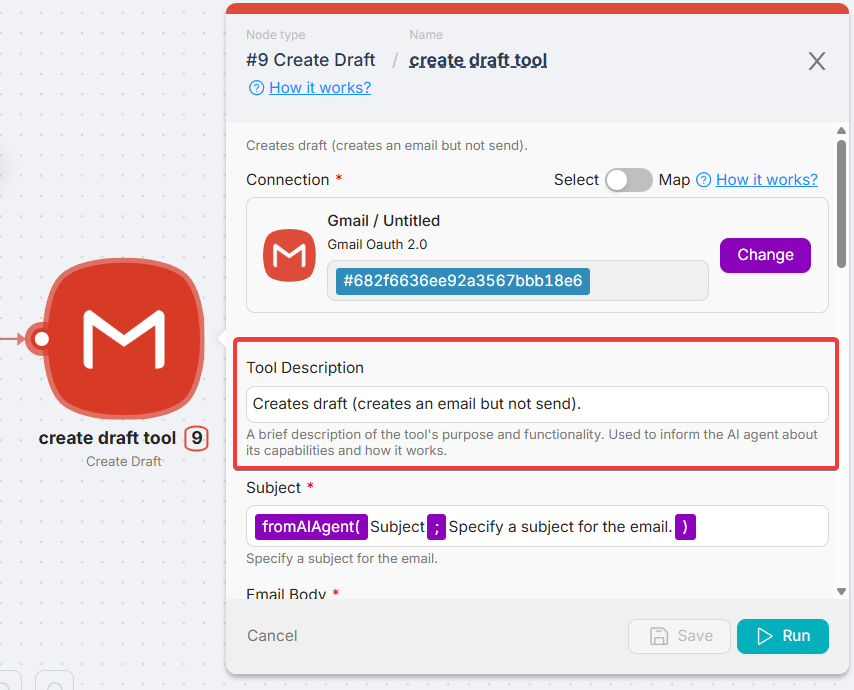
Each tool should include a short description that explains its function. This is used by the agent to decide when (and if) to use it.
Note: The tool description is not just for documentation — it is also passed via API and directly affects how the agent reasons about and chooses to call the tool. A vague or missing description can lead to the tool being ignored or misused.
Good examples
create_event_tool: "Creates a new calendar event using title, time, and participant list."
Poor examples
"Does stuff with the calendar"
"Test tool"
Tip: Keep descriptions short, specific, and action-oriented. Write them for the agent — not just for humans.
Testing
Always test each tool in isolation before connecting it to an agent. Validate that the tool:
- Executes reliably with real input
- Returns usable results
- Fails gracefully when needed
AI Agent Node
Core component for building LLM-based automations using instructions, tool calls, and contextual memory.
Think & Plan Tools
Reasoning tools that improve AI Agent accuracy and transparency.
Need Help? Ask the community
If something on this page is missing or unclear, post on the Latenode community forum. Our team and other users usually reply quickly.