
Custom LLM Connection
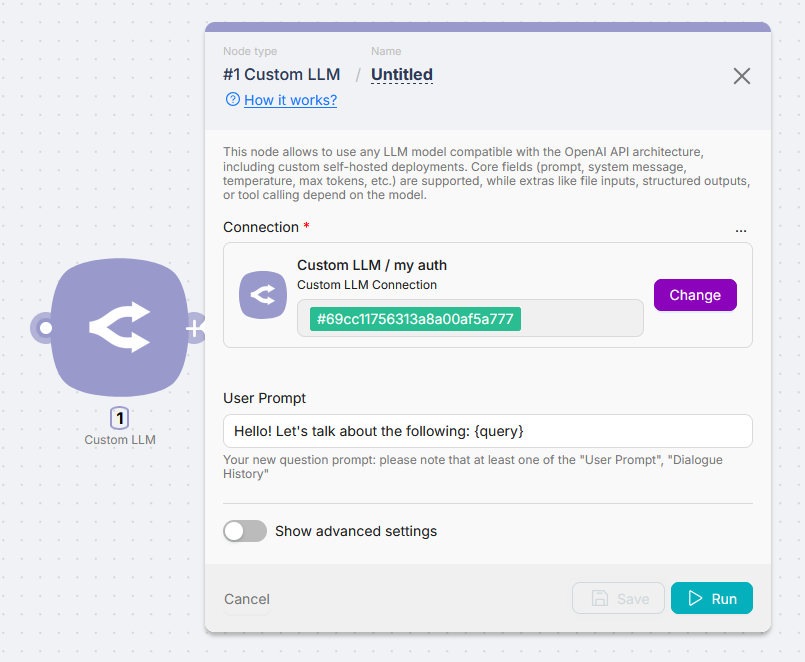
The Custom LLM node talks to any OpenAI-compatible API: Groq, Perplexity, Ollama, Azure OpenAI, or your own server. You store the provider API Key and Base URL in a Custom LLM connection.
No provider API key?
Use a Plug and Play app node from the catalog: you do not enter a provider key there (billing is PnP). For OpenAI models, see ChatGPT (Send Message to ChatGPT).
Connection setup
Before running the node, create a Custom LLM connection with provider credentials.
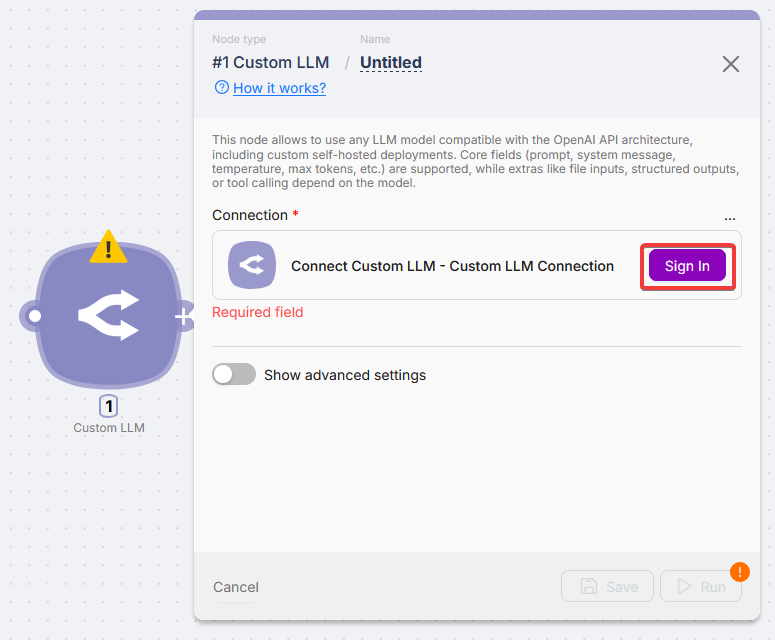
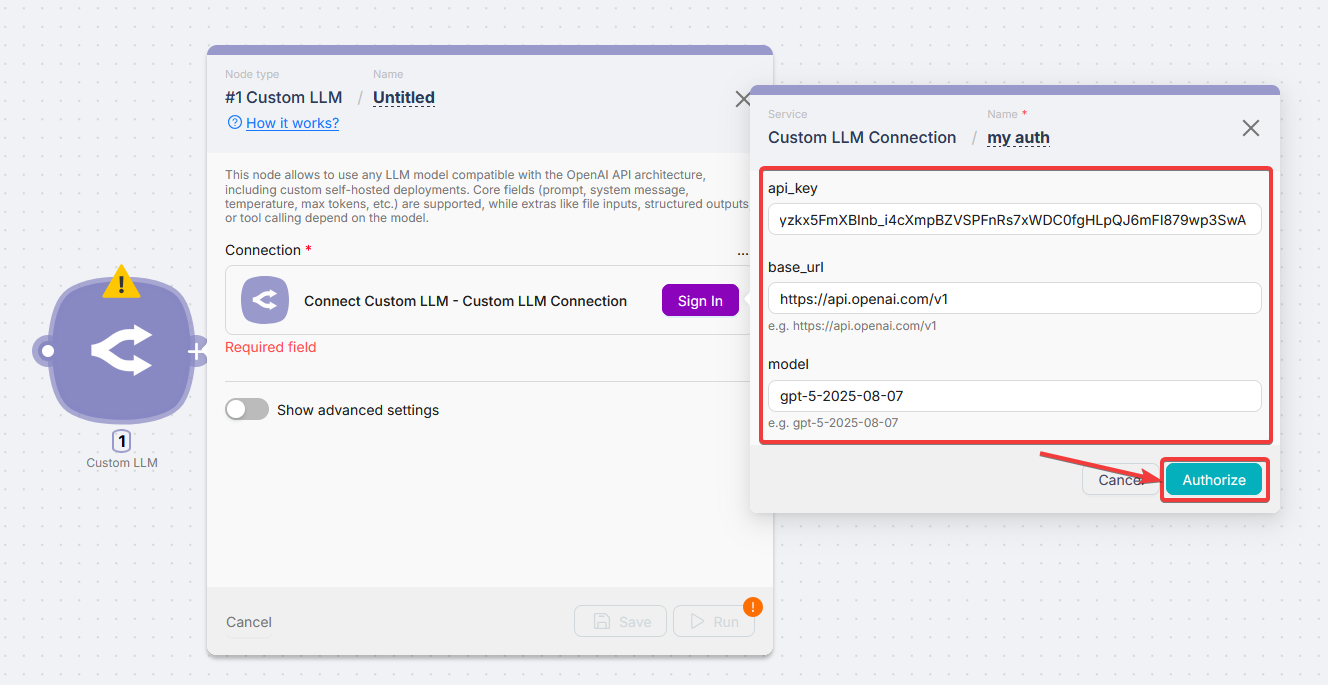
| Field | Description |
|---|---|
| API Key | Key from the provider |
| Base URL | OpenAI-compatible base URL |
| Model | Provider model id (e.g. llama-3.3-70b-versatile) |
Base URL examples
| Provider | Base URL |
|---|---|
| OpenAI | https://api.openai.com/v1 |
| Groq | https://api.groq.com/openai/v1 |
| Perplexity | https://api.perplexity.ai/chat/completions |
| Azure OpenAI | https://[YOUR-RESOURCE].openai.azure.com/openai/deployments/[MODEL-NAME]/chat/completions?api-version=2024-02-15 |
Getting structured output
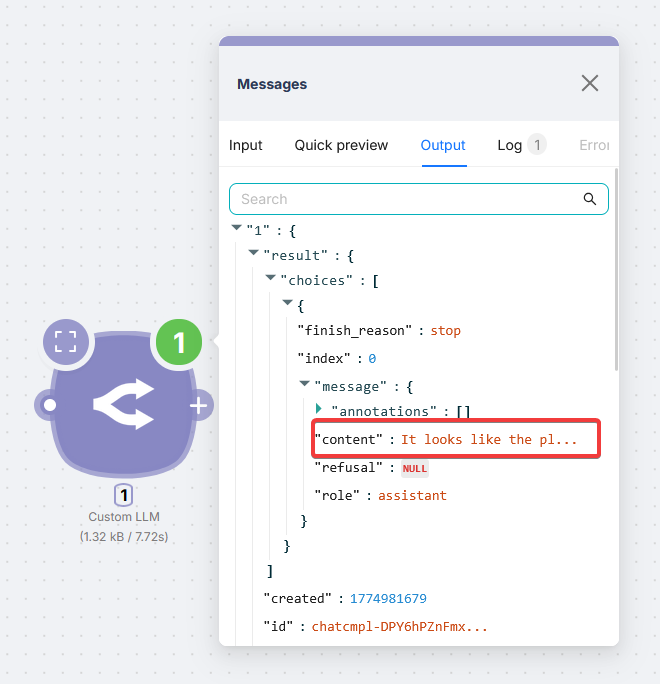
Enable Structured Output and ask for JSON in the prompt when downstream nodes need structured data.
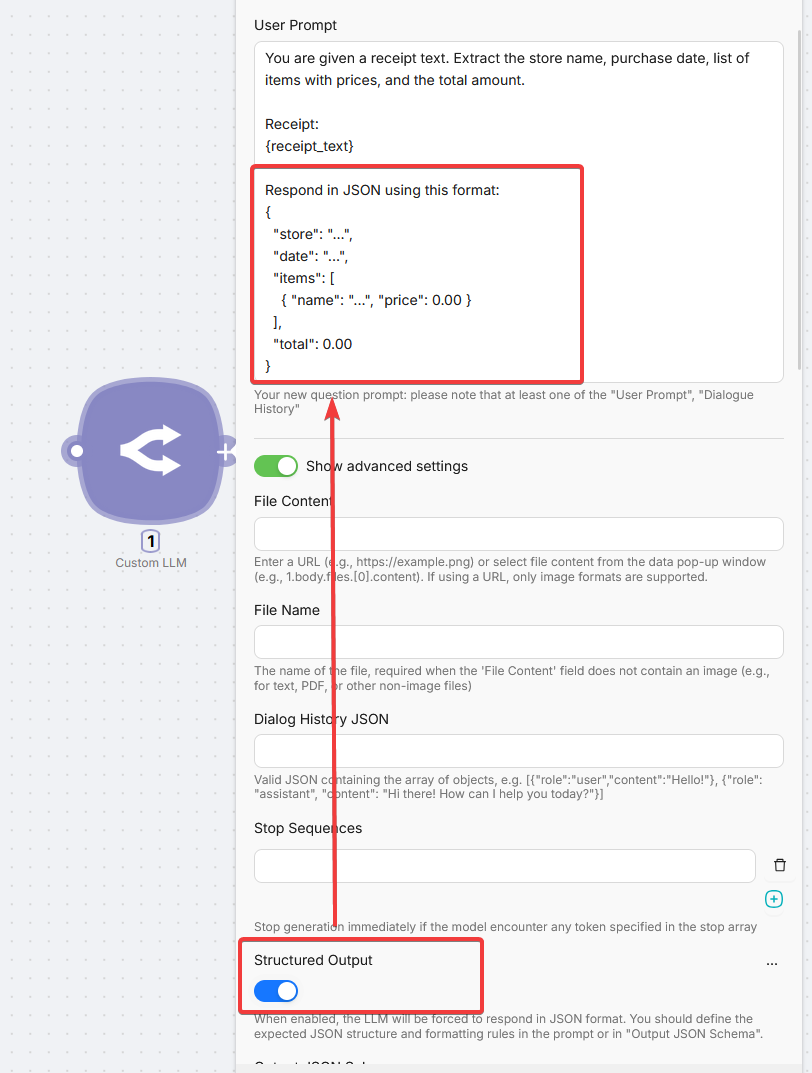
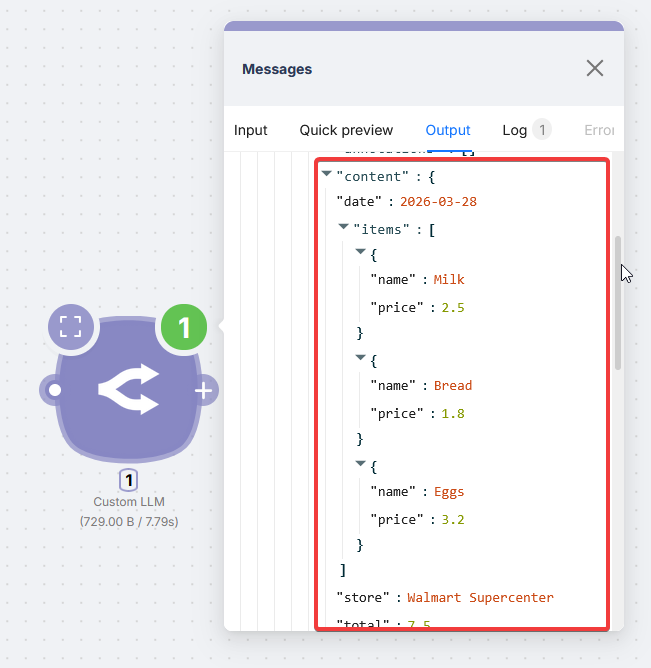
Example (receipt):
You are given a receipt text. Extract the store name, purchase date, list of items with prices, and the total amount.

Receipt:
{receipt_text}

Respond in JSON using this format:
{
  "store": "...",
  "date": "...",
  "items": [
    { "name": "...", "price": 0.00 }
  ],
  "total": 0.00
}
Advanced: Output JSON Schema
Support depends on the model; check the provider docs.
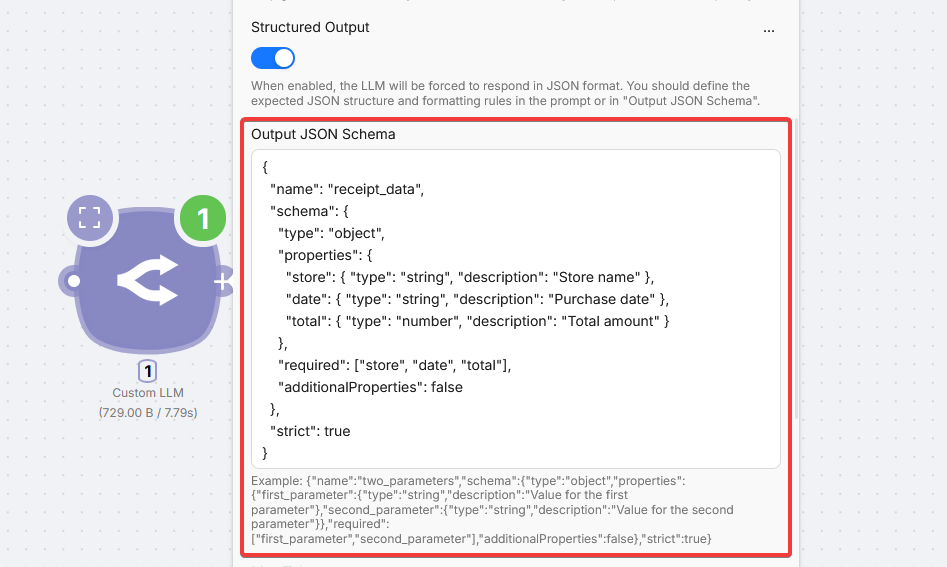
{
  "name": "receipt_data",
  "schema": {
    "type": "object",
    "properties": {
      "store": { "type": "string", "description": "Store name" },
      "date": { "type": "string", "description": "Purchase date" },
      "total": { "type": "number", "description": "Total amount" }
    },
    "required": ["store", "date", "total"],
    "additionalProperties": false
  },
  "strict": true
}
Fields
Core options (prompt, temperature, max tokens) work on compatible APIs. Files, structured output, and tools depend on the model and provider.
Setting up App Nodes
How file and folder pickers work in app nodes—loading, search, and labels.
Discord
Send messages, manage channels and roles, and react to Discord events from Latenode scenarios.
Need Help? Ask the community
If something on this page is missing or unclear, post on the Latenode community forum. Our team and other users usually reply quickly.